Dramix® Loop™

Download
Please provide the following details :
This is a mandatory field
This is a mandatory field
Please enter a valid email (e.g. johnsmith@domain.com)
Please provide the following details :
This is a mandatory field
This is a mandatory field
Please enter a valid email (e.g. johnsmith@domain.com)


Written by Hendrik Thooft
Starting on a positive note: The world today is, in many ways, a better place than it was 500 years ago. People generally live in safer homes, enjoy better nutrition, and benefit from advances in healthcare that make life longer and healthier.
However, progress comes with new challenges. Industrialization on an unprecedented global scale has driven up carbon emissions, accelerating climate change.
What often receives less attention is our reliance on “finite” natural resources. Materials like iron ore, aggregates and sand may seem abundant, but they are not limitless.
To ensure a sustainable future, recycling, powered by renewable energy is not just an option, it is a moral responsibility.
1. Concrete
Concrete , one of the most sustainable building materials

Concrete is often criticized because cement production, the binder in concrete, accounts for ~6–8% of global CO₂ emissions. That headline is real, but it needs some further explanation.
When we evaluate materials on a whole, “life performance”, durability, service life, and circularity, the sustainability profile of concrete changes substantially.
Interior of the Pantheon in Rome, author: Nicholas Hartmann
Durability that shifts the math
The Pantheon’s nearly 2,000‑year‑old unreinforced concrete dome illustrates how “long‑life” concrete can spread embodied carbon over many generations, reducing replacements and cumulative impacts. Longevity is a core sustainability benefit.
High circularity at end‑of‑life
With standard processing (crushing, screening, metal removal), virtually 100% of a demolished concrete element’s mass can be reused in unbound applications such as road base or sub‑base. This is already mainstream in many markets.
Closed‑loop into new concrete. Recycled concrete aggregate (RCA) routinely replaces ~10–30% of coarse aggregate in structural and paving mixes while meeting performance requirements; higher shares are feasible with advanced quality control and optimized mix design.
Reusing the binder fraction. Beyond aggregates, parts of the cement paste can be recovered:
Unprocessed Recovered Cement Paste (RCP) can substitute up to ~15% of cement as a non‑reactive filler (like limestone) with no performance loss in suitable cements/mixes.
Carbonated RCP (cRCP) acts as a reactive Supplementary Cementitious Material (SCM), enabling ~10–30% binder substitution in composite cements/concretes with maintained or improved performance when mixes are optimized.
Carbonation partly offsets emissions. Hardened concrete reabsorbs CO₂ during service life and after demolition—a recognized carbon sink that partially offsets calcination emissions from cement production; robust accounting frameworks are emerging.
Decarbonizing the “front end.” Pair these circular practices with lower‑clinker binders, renewable energy for production, and carbon capture at kilns (to address unavoidable process CO₂), and the initial footprint of cement falls sharply along credible industry pathways.
Bottom line:
Combine exceptional durability, high mass‑recyclability, binder reuse, CO₂ uptake, and decarbonized cement production, and concrete moves from climate liability to sustainable choice when specified and managed holistically across its life cycle.
2. Tyres
End-of-Life” Tyres: Turning Waste into Valuable Resource
Every year, millions of tyres reach the end of their life cycle, often seen as waste and posing environmental challenges. The tyres are dumped in desserts or used as landfill. This poses long term pollution issues.
Today, this is gradually changing. End-of-life tyres are becoming a key resource in the circular economy. Recycling these tyres reduces landfill pressure and prevents harmful pollution, while unlocking new opportunities for sustainable innovation.
Advanced processes transform old tyres into rubber granules, steel, and even energy, saving natural resources and cutting carbon emissions. This shift turns disposal into value creation, closing the loop for the tyre industry. From waste to resource, end-of-life tyres are driving progress toward a greener future.
A radial tyre consists of the following components:
Today the steel is sent back to foundries for remelting.
3. Steel
Steel: The Infinite Loop of Sustainability
Steel is more than a building material—it’s a cornerstone of circularity.
Unlike many resources, steel can be recycled endlessly without downcycling.
Every tonne of recycled steel saves raw ore, energy, and significant CO₂ emissions.
Its durability ensures long life in structures, vehicles, and infrastructure.
When products reach end-of-life, steel returns to the loop, ready for reuse.
This closed cycle reduces waste and drives resource efficiency worldwide.
Modern recycling processes make steel one of the most recovered materials on Earth.
From skyscrapers to household appliances, steel keeps delivering value.
Overall, the global steel industry recycles more than 600 million tonnes of scrap annually which represents about 30 % of the overall steel consumption. making steel the most recycled material in the world.
Its infinite recyclability makes it a true champion of sustainable industry.
Steel isn’t just strong—it’s the backbone of a greener future.
1. Introduction
Loop; steel fibre concrete reinforcement born from “end of life“ tyres
The tyre is shredded into small pieces, creating the feedstock for producing high-performance steel fibres. Through a precisely engineered process, rubber and other non-metallic components are separated from the steel, resulting in exceptionally clean fibres with a tensile strength of up to 2,700 MPa.
In the subsequent processing stage, fibres are accurately classified into defined lengths. This critical step ensures compliance with the stringent distribution requirements specified in EAD 260010-00-0301.
Available fibre lengths range from 15 mm to 25 mm, offered in 5 mm increments to meet diverse application specifications.
2. Performance
There are three principle Dramix Loop solutions
A cocktail of Dramix®4D 80/60BG and Dramix® Loop fibres.
Sustainability meets “value”
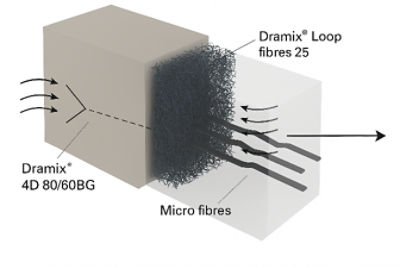
How Do Micro Loop Fibres Enhance the Performance of Steel Fibre Reinforced Concrete (SFRC)?
Dramix® Loop 25 fibres introduce a significant improvement in crack control and stress distribution within SFRC. Each kilogram of Dramix® Loop 25 contains approximately 96,000 individual fibres, compared to 4,644 fibres/kg for Dramix® 4D 80/60BG. This represents 20 times more fibres per kilogram, creating an ultra-dense reinforcement network.
When an applied strain exceeds the concrete’s tensile strain capacity and microcracks begin to form, this dense network acts immediately to distribute stresses evenly across the section. While Dramix® 4D 80/60BG macro steel fibres remain the primary reinforcement, the micro steel fibres reduce peak stresses within the section and transfer loads more uniformly toward the macro fibres ; a phenomenon often referred to as the “smearing effect.”

This effect is most pronounced during the early crack formation phase (up to fR1). As cracks propagate into macrocracks (around fR3), the relative contribution of micro fibres decreases, though the combined system still offers superior overall performance compared to single-macro fibre solutions.
Optimal results are achieved with a fibre cocktail combining Dramix® 4D and Dramix® Loop fibres at a replacement ratio of 20% to 33%.
In addition to mechanical benefits, Dramix® Loop fibres deliver sustainability advantages: with an EPD value of only 0.04 kg CO₂e/kg, carbon savings (%) closely match the replacement ratio, supporting low-carbon concrete design.
Dramix® loop in a low dosage for temperature and shrinkage
The Dramix® Loop fibres can also be used as sole concrete additive. But by the lack of the Macro steelfibers they offer limited strength to the concrete matrix. However, due to the dense fibre matrix they can offer good crack resistance for lightly loaded ground supported structures.
For meeting serviceability limit states (SLS) requirement 10 kg/m³ Dramix® loop can replace 3 kg/m³ macro synthetic fibres.
In that respect they offer a perfect alternative to macro synthetic fibres.
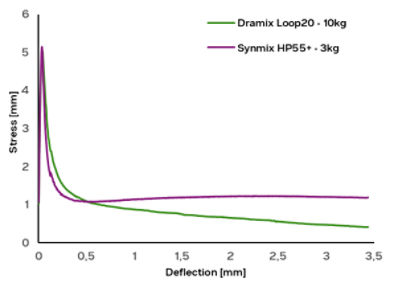
And the best ; Cost wise the Dramix® loop solution is competitive to a macro synthetic solution at the same SLS performance level.
Adding sustainability and recyclability to the equation and Dramix® loop should be the solution of choice.
Dramix® in a high dosage rate for UHPC
Ultra-High-Performance Concrete (UHPC) and Fibre Reinforcement
Ultra-high-performance concrete (UHPC), with compressive strengths up to 160 MPa, is inherently brittle. To compensate, traditional UHPC designs employ very high reinforcement ratios, typically between 2.0 and 3.5 vol.%. Unlike normal-strength concrete, UHPC design stresses are considered only for small crack openings, making early crack control critical.
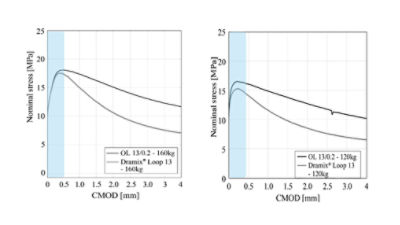
The test results clearly demonstrate that Dramix® Loop fibres deliver equivalent performance within the crack width range that governs UHPC design.
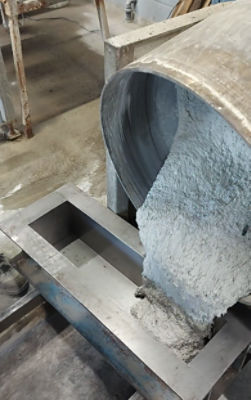
Workability trials at dosages up to 200 kg/m³ showed no adverse effects compared to conventional straight micro steel fibres.
Moreover, the combination of high fibre dosage and an extremely low EPD score (0.04 kg CO₂e/kg) results in substantial carbon savings. Compared to traditional solutions, the environmental benefit of Dramix® Loop fibres is significant, reinforcing their role in sustainable UHPC design.
Hereby a couple of possible applications. However, multiple other applications are possible and under development. Just make your imagination work wonders !
🗸 Flooring
Our first floor incorporating Dramix® Loop technology was constructed in our own Bekaert facilities. The project involved casting a 2,000 m² seamless floor in which several innovations were combined.
The reinforcement concept, based on Sigmafloor®, used a hybrid system consisting of CCL post‑tensioning, 15 kg/m³ of Dramix® 4D 80/60 BGE, and 5 kg/m³ of Dramix® Loop 20. The post‑tensioning strands were installed in an innovative, patented configuration: they were placed at the bottom of the slab to enable fast and practical installation, and only at the slab edges where they lifted toward the centre. This approach significantly improved productivity during casting.
A second innovation was the introduction of Dramix® Loop fibres. We replaced 5 kg/m³ of high‑performance Dramix® 4D 80/60 BGE fibres with an identical dosage of Dramix® Loop 20. The resulting concrete displayed a dense network of both micro‑ and macro‑steel fibres, while maintaining excellent workability. No special equipment was required for installation or finishing the floor.
The slab was levelled using a manual concrete power screed. During the initial phase of power floating, a dry shake was applied at a standard rate of 3–4 kg/m².
The result is something to be proud of: a 2,000 m² monolithic, crack‑free floor with a perfectly finished surface—achieved without any special tools, materials, or processes, and with no fibres visible at the surface.
Other applications where Dramix® loop can easily be used are
🗸 Underground – Shotcrete
🗸 Precast
🗸 UHPC Panels
Once the Dramix® Loop fibres are mixed into the concrete, the rest of the production process remains unchanged.
For flooring, traditional placing techniques can be used.
For shotcrete, standard spraying equipment is sufficient.
For precast, the usual molds and procedures apply.
However...
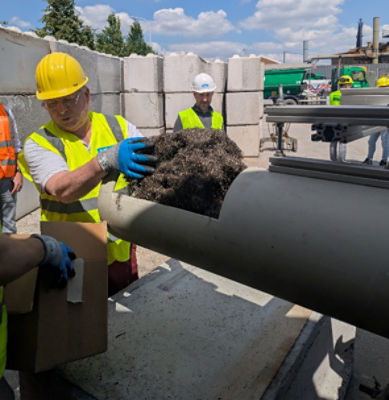


Introducing the fibres requires special attention
Inside the box, the small, thin, curly fibres are densely packed and entangled. If the entire box is emptied directly onto the conveyor belt, this will lead to fibre clumping and local concentrations in the concrete mix.
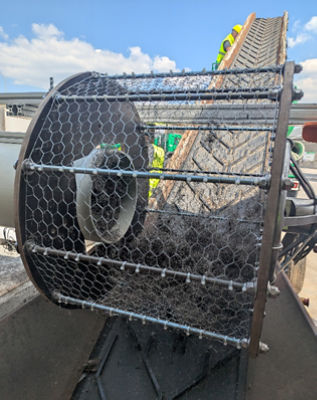
To ensure a uniform fibre distribution, without fibre balls, the fibres must be properly disentangled before being added to the conveyor belt.
Our first solution: prototype disentanglement machines
For the first floor produced with Dramix® Loop fibres, we developed a prototype disentanglement equipment which we installed at the batching plant. The rotating drum hovered above the conveyor belt and sprinkled the fibres onto it, resulting in an even distribution into the truck mixer.
This process did not slow down the mixing operation, as the Dramix 4D 80/60 BGE fibres were added simultaneously.
Ongoing improvements
Since then, we have further developed the disentanglement machine. The latest version is more robust, faster disentangling, and safer to operate, ensuring reliable fibre integration in all concrete production environments.
Dramix® Loop represents a significant step forward in sustainable construction. By transforming end‑of‑life tyres into high‑performance steel fibres, we close a vital material loop while delivering tangible engineering value. The fibres enhance crack control, improve stress distribution, and increase robustness across a wide spectrum of applications—from industrial flooring and shotcrete to precast elements and UHPC.
Extensive laboratory testing has enabled us to establish reliable performance design values for the most common concrete classes. Combined with insights gained from executing reference job sites, we have demonstrated not only the technical validity of the system but also its practicality and ease of implementation in real construction environments.
With their exceptionally low environmental footprint, strong mechanical performance, cost efficiency, and seamless integration into standard concrete production processes, Dramix® Loop fibres offer a compelling reinforcement solution for future‑proof concrete design.
As we continue to advance our fibre handling and disentanglement technology, the direction is clear: Dramix® Loop provides a scalable, circular, and dependable reinforcement concept that supports the construction industry in building more sustainably—without compromising quality, productivity, or structural performance.

Copyright © 2026 Bekaert. All rights reserved


